BLOG #100: The State of Senior Design: 100 Truths for the Era of the AI Orchestrator

Updated: Apr 19

The Death of the Pixel Pusher
If you feel a knot of anxiety when you look at the current design landscape, you aren't alone. Between waves of industry layoffs, the saturation of AI-generated interfaces, and a global "UX Maturity" plateau, the role we once knew is disappearing. For a decade, we were rewarded for being "Pixel Pushers"—specialists who could execute tickets with high fidelity and predictable speed.
That era is over.
UX isn’t dying; it is shedding its skin. We are witnessing a brutal, necessary evolution. The hard truth is that the "Senior Designer" of 2020 is effectively a "Junior" in 2026. If your value is tied solely to your ability to move components around a canvas or document a design system, you are competing with a machine that doesn't sleep and a market that no longer wants to pay a premium for "Design as a Service."
The shift we are navigating is a move toward Design as Orchestration. To survive the next five years, you must move beyond the ticket. The modern leader doesn't just execute; they lead business strategy and manage complex AI systems. We are stepping out of the usability lab and into the boardroom. We are no longer just building screens; we are orchestrating the intelligence and the business logic that sits behind them.
This manifesto is the culmination of 100 posts—a collection of 100 uncomfortable truths designed to help you stop pushing pixels and start orchestrating change.

Beyond Seniority: Orchestrating Your Influence in the Age of AI
The Seniority Trap
Most designers believe that tenure is a ladder. They think that by repeating the same year of experience ten times, they will eventually be granted a seat at the table.
But seniority is a trap. You can be a "Senior Designer" and still be a tactical order-taker. You can have the title and still be excluded from the conversations that actually define the product's direction. True leadership isn't granted; it is orchestrated.
The Shift to Orchestration
In the age of AI, the "Craft" is being commoditized. If your value is purely in your ability to push pixels or build components, you are competing with a machine that doesn't sleep. To thrive, you must shift from a Tactical Specialist to a Product Orchestrator.
An Orchestrator doesn't just design the interface; they design the logic, the business alignment, and the human narrative that makes the product successful.

The Path Forward: Six Dimensions of Growth
To move from Tier 1 to Tier 3, you must master the six themes we have explored over the last 100 weeks:
The Craft Moving from "look and feel" to robust Information Architecture.
Business Fluency Learning to speak the language of the boardroom (P&L, ROI, and KPIs).
AI Orchestration Using AI as a force multiplier for strategy, not just a shortcut for production.
Diplomatic Influence Navigating organizational friction and turning stakeholders into advocates.
Career Trajectory Treating your career as a product and building a brand of ROI.
Narrative Authority Using storytelling to align an entire company around a human-centered vision.

The 100 Truths: A High-Density Manifesto
These truths are the "Golden Threads" of a decade in the trenches. Each represents a critical decision point in your evolution from designer to orchestrator.
1. The Modern Craft
# | Concept | Description | Link |
|---|---|---|---|
14 | IA is the Structural Integrity of UX | Information Architecture is the only thing that prevents a total redesign in six months. | |
15 | Design is Mental Mapping | If you can’t map the user’s mental model, you are just decorating a maze. | |
92 | Hierarchy as a Psychological Tool | Visual hierarchy is a psychological weapon; use it to guide, not to confuse. |
2. The Business Strategist
# | Title | Description | Link |
|---|---|---|---|
42 | The Bridge Architect | Your job is to bridge the gap between product management and engineering. | |
49 | The Real Cost of Bad UX | The hidden cost of bad UX is higher than the salary of your entire design team. | |
77 | Strategic Alignment | Aligning design goals with business strategy is the difference between a "feature" and a "product." |
3. The AI Orchestrator

THE DESIGN INFLUENCE INDEX
Before you can lead, you must know where you stand. Use this worksheet to pinpoint your current operational maturity and identify the exact skills gap standing between you and the role of a Product Orchestrator.

The Senior UX Curriculum: 100 Posts of Strategy
This is not just a list of blogs; it is your roadmap for career acceleration.
1. The UX Foundation and Craft
The mechanics of structural integrity and logic.
# | Title | Link |
14–16 | The IA Trilogy: Foundation, Scale, and Search | |
5 | Mastering the 3 C’s of UX | |
46 | Orchestrating a Design System |
2. Strategic Design and Business Alignment
How to turn design into a competitive business advantage.
# | Title | Link |
71–78 | The "Rethink" Strategic Series | |
69 | Impact Metrics for Business Value | |
39 | Managing the Hidden Costs of UX Debt |
3. The Future-Ready Designer (AI and Innovation)
Navigating the intersection of AI and human creativity.
# | Title | Link |
80 | AI Prompt Playground: From Rookie to Wizard | |
31 | 9 Creative Ways to Use AI in UX | |
43 | UX in 2025: Weird, Wild, and Usable |
4. UX Leadership and Stakeholder Diplomacy
Leading with influence and finding calm in the chaos.
# | Title | Link |
29 | Building Bridges with Challenging Stakeholders | |
21 | Designing Zen: Mastering Chaos in UX | |
22 | Leadership, Mentoring, and Coaching |
5. Portfolio Mastery and Career Acceleration
Crafting a professional identity that commands a seat at the table.
6. Psychology, Empathy and Human-Centered Design
Understanding the soul behind the screen through narrative.
# | Title | Link |
81–96 | The 10,001 UX Nights Storytelling Series | |
6 | Empathy: The Secret Ingredient | |
73 | De-risking Decisions with Critical Thinking |

A Letter to You, The Future Designer
The 5-Year Outlook (2026–2030)
As we look toward the end of the decade, the "Senior Designer" role will undergo its final transformation into the Product Orchestrator. In this new reality, you will not be judged by the fidelity of your Figma files, but by your ability to direct autonomous agents, interpret deep data telemetry, and negotiate the ethical boundaries of automated experiences. The "screens" will design themselves; you will be the one designing the logic, the ethics, and the intent.
Your "Stop Pushing Pixels" Action Plan
Your transformation begins tomorrow morning
Audit Your Calendar Stop attending every "UI Sync" and start booking time with your Product Manager to review the Profit and Loss statement.
Prompt the System, Not the Screen Instead of drawing a table, write a prompt for an AI agent to generate a dynamic data visualization system based on your user research.
Speak in Outcomes Every time you present a design, lead with the business metric it moves, not the "user delight" it creates.
The Orchestrator’s Era starts now.
Are you ready to lead?
Apendix
All the skills you need conveniently located in 1 place.
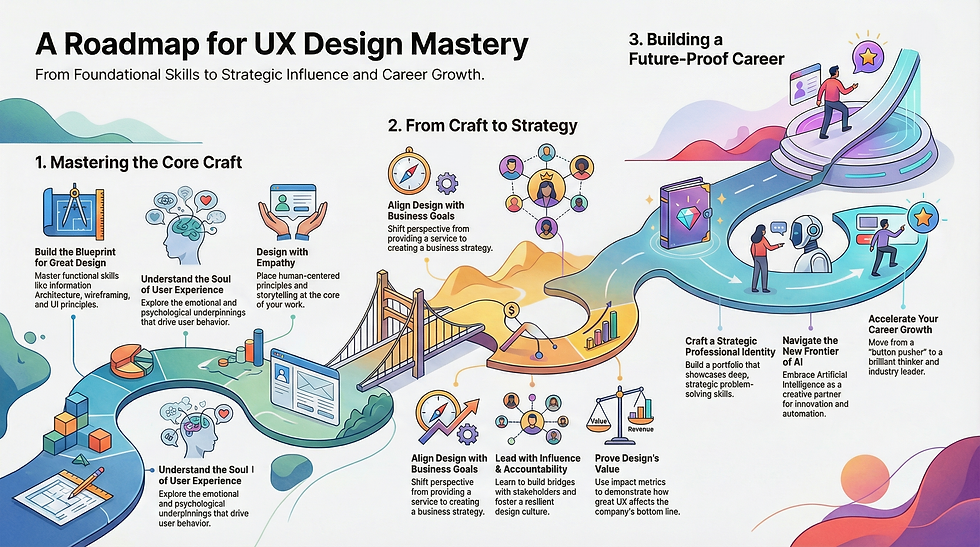
1. The UX Foundation and Craft
The Blueprint of Great Design
This section serves as the fundamental library for every designer’s toolkit. It covers the "how-to" of the industry, moving beyond simple aesthetics into the structural integrity of digital products. Here, users will discover the mechanics of Information Architecture, the psychological impact of color theory, and the essential "3 C's" that separate professional design from hobbyist work. Whether you are blueprinting a complex digital space or refining the accessibility of a wireframe, this pillar focuses on mastering the core competencies required to build interfaces that are not only beautiful but functional and logical.
The Information Architecture Trilogy
# | Blog Title | URL |
14 | Information Architecture Part 1: Blueprinting Digital Spaces | |
15 | Information Architecture Part 2: Mapping & Modeling | |
16 | Information Architecture Part 3: Mastering Complexity |
Foundational Deep Dives
# | Blog Title | URL |
4 | Breaking the Ice: Kickstart Your UX Project | |
5 | The Designer’s Trifecta: Mastering the 3 C’s | |
13 | Color Secrets in UX Design: How Hues Shape Behavior | |
24 | The Art of Simplicity: Designing Experiences That Just Work | |
26 | Mapping the UX Maze: Journeys and Flows Dynamic Duo | |
46 | UI Symphony: Orchestrating a Design System | |
59 | Mastering Interactive Display Design for Maximum Engagement | |
62 | White Space, Right Place: The Secret Sauce of Stunning UI | |
63 | UI vs UX: Why Great Design Is More Than Pushing Pixels |
2. Strategic Design & Business Alignment
Design as a Competitive Advantage
Moving from the "how" to the "why," this section is designed for the practitioner who wants a seat at the table. It explores the critical intersection of user advocacy and business viability. Users will learn to speak the language of stakeholders by understanding the hidden costs of bad UX, the concept of UX debt, and the specific metrics that prove design's impact on a company's bottom line. This pillar is about shifting the perspective of design from a "service" to a "strategy," ensuring that every pixel moved serves a business goal while simultaneously solving a real human problem.
The "Rethink" Strategic Series
# | Blog Title | URL |
71 | Rethink Your UX: A Modern Playbook | |
74 | Rethink Your Process: Lean Thinking | |
77 | Rethink Your Goals: Strategic Thinking | |
78 | Rethink Everything: Summary & FAQ |
Business and Impact Deep Dives
# | Blog Title | URL |
2 | 20+ Key Focus Areas for a Strategic Design Vision | |
8 | Mastering Design Innovation Factors | |
9 | Data-Driven Design: Turning Numbers into UX Magic | |
25 | The Sweet Spot: Merging User Needs with Business Goals | |
39 | UX Debt: The Price of "We'll Fix It Later" | |
42 | Business, Product Management, and UX Design, Who Does What? | |
47 | Balancing Risk and Reward in UX Design | |
49 | The Hidden Cost of Bad UX: Why Investing in UX Matters | |
57 | Why UX Needs to Be Proactive, Not Reactive | |
69 | Day 6 - Impact Metrics: Proving Business Value |
3. The Future-Ready Designer (AI and Innovation)
Navigating the New Frontier
The landscape of design is shifting beneath our feet, and this section is the compass for navigating it. It focuses on the rapid emergence of Artificial Intelligence and its role as a creative partner rather than a replacement. Users will discover practical ways to use AI for prompt engineering, workflow automation, and predictive design. Beyond just tools, this pillar examines the mindset required to stay relevant in 2025 and beyond, exploring design trends like skeuomorphism's return and the wild, weird future of usable technology. This is where innovation meets execution for the modern, high-tech designer.
The AI and Innovation Hub
# | Blog Title | URL |
11 | AI + UX: Designing the Future Together | |
31 | Harnessing the Future: 9 Creative Ways to Use AI | |
34 | From Skeuomorphism to AI: UX Designer’s Guide to Trends | |
35 | Intro to AI for UX Designers: Smarter Design Starts Here | |
43 | UX in 2025: The Future is Weird, Wild, and Usable | |
80 | AI Prompt Playground: From Rookie to Wizard | |
97 | The 2026 UX Roadmap: Agentic UI and Sustainability |
Innovation and Creativity
# | Blog Title | URL |
3 | Where Does a Brilliant Idea Come From? | |
10 | Mastering Creative Concept Development | |
41 | Unleashing Creativity: Fun UX Design Challenges | |
48 | Level Up Your UX: How Gamification Turns Users Into Superfans |
4. UX Leadership and Stakeholder Diplomacy
Leading with Influence and Accountability
Great design is often more about communication than creation. This section is dedicated to the "soft skills" that define design leadership. It covers how to build bridges with difficult stakeholders, how to mentor the next generation of designers, and how to maintain accountability within a team. Users will explore the concept of "UX Zen"—finding calm in the chaos of product development—and learn to transform criticism into actionable insights. This pillar is essential for anyone moving into a senior or leadership role who needs to influence organizational culture and foster a resilient design environment.
The Leadership Handbook
# | Blog Title | URL |
1 | 9 Design Leadership Principles to Follow for Success | |
17 | Level Up, Rung by Rung — The UX Guide | |
20 | Redesigning Criticism: Feedback into Insights | |
21 | Designing Zen: Mastering Chaos in UX | |
22 | Designing Influence: Leadership, Mentoring, Coaching | |
23 | Traits of a High-Performing UX Designer | |
27 | Pixels & Code: Bridging the Gap | |
29 | UX Diplomacy: Challenging Stakeholders | |
33 | Unlocking Creative Synergy: Bridging the Gap | |
44 | Pixels, Opinions, and Panic: How to Take UX Feedback | |
53 | UX Mythbusters: 9 Lies We Tell Ourselves | |
54 | The Emotional Rollercoaster of UX Design | |
60 | The Ultimate UX Designer Success Principles | |
61 | Navigating Unclear or Shifting Requirements | |
99 | 100+ Tips for UX Design Leadership: Shipping at Scale |
5. Portfolio Mastery and Career Acceleration
Crafting a Professional Identity
This section is a focused boot camp for the professional evolution of a designer. It centers on the "Day 1–7" series, providing a step-by-step masterclass in building a portfolio that recruiters actually want to read. Users will learn the anatomy of a winning case study, how to write for "skimmers," and how to avoid the rookie mistakes that haunt even the most talented designers. Beyond just the portfolio, this pillar covers career-long growth strategies—moving from a "button pusher" to a "brilliant thinker"—ensuring that your work not only looks professional but demonstrates deep, strategic problem-solving.
The 7-Day Portfolio Series
# | Blog Title | URL |
|---|---|---|
64 | Day 1 - Essential Elements Every UX Portfolio Must Have | |
65 | Day 2 - What Your Portfolio is Sharing About You? | |
66 | Day 3 - Anatomy of a Winning UX Case Study | |
67 | Day 4 - Writing for Skimmers: Case Study Structure | |
68 | Day 5 - 5 Biggest Mistakes in My First UX Portfolio | |
69 | Day 6 - Impact Metrics: Selecting and Visualizing the Metrics that Matter | |
70 | Day 7 - Portfolio or Graveyard? |
Career Growth and Interview Prep
6. Psychology, Empathy and Human-Centered Design
The Soul of User Experience
At its heart, UX design is about humans. This section explores the emotional and psychological undercurrents that drive user behavior. Through the lens of the "10,001 UX Nights" storytelling series, users will see complex design theories transformed into engaging narratives. This pillar covers the "why" behind human instincts—exploring empathy as a secret ingredient, the importance of critical thinking in de-risking decisions, and specialized design challenges like creating for six-year-olds. It is a discovery space for those who want to understand the people behind the screens and build products that resonate on a deeply human level.
The 10,001 UX Nights Series
# | Blog Title | URL |
|---|---|---|
81 | 10,001 UX Nights - The Prologue | |
82 | Night 1: The A–Z Lexicon of the Digital Realm | |
83 | Night 2: The Scroll of Human-Centered Design | |
84 | Night 3: The Labyrinth of Information Architecture | |
85 | Night 4: The Enchanted Wireframe | |
86 | Night 5: The Tale of Microinteractions | |
87 | Night 6: The Potion of Usability Testing | |
88 | Night 7: The Oracle of Accessibility | |
89 | Night 8: The Mirage of Responsive Design | |
90 | Night 9: The Map of User Journeys | |
91 | Night 10: The Spell of Visual Hierarchy | |
92 | Night 11: The Compass of UX Research | |
93 | Night 12: The Dance of Interaction Design | |
94 | Night 13: The Garden of Microcopy | |
95 | Night 14: The Mirror of Conversion | |
96 | Night 15: The Alchemy of Prototyping |
Psychology and Research Foundations
# | Blog Title | URL |
|---|---|---|
6 | Empathy: Secret Ingredient in UX Magic | |
7 | Discovering Discipline: The Key to Success | |
12 | Beyond the Pixels: Why UX Design is (almost) Everything | |
18 | Problem Solving Mastery for UX Designers | |
28 | UX Alchemy: Turning Ideas Into Experiences | |
30 | Tiny Humans, Big Ideas: Designing for Six-Year-Olds | |
32 | Once Upon a Wireframe: Storytelling in UX | |
37 | Art vs. Design: Is UX Design Just Fancy Art? | |
40 | Empathy: Secret Ingredient for Exceptional Design | |
45 | Stop Solving the Wrong Problem | |
50 | 4 UX Design Strategies to Simplify Complex Systems | |
51 | Transform Your Designs with Effective UX Strategies | |
72 | Rethink Your User: Design Thinking | |
73 | Rethink Your Biases: Critical Thinking | |
75 | Rethink Your Instincts: Data-Driven Thinking | |
76 | Rethink Your Impact: Human-Centered Thinking | |
79 | Beyond the Usability Lab: Inner Research Maverick | |
98 | From Brainstorm to Breakthrough: Impactful Projects |


Comments