Design Any Product, Part 2: Research (Stop Guessing, Start Knowing)

Welcome back to Part 2 of the Design Any Product series. If Part 1 was about defining what you are building, Part 2 is about figuring out who you are building it for, what they actually need, and what the rest of the market is already doing about it.

Research is where assumptions die and decisions get made.
This is the phase that converts the gut feel from Part 1 into evidence you can defend. Done well, it gives your design decisions a foundation that holds up in a boardroom. Done badly, it leaves you designing on vibes and rebuilding twice.
3 research methods do most of the work.
Stakeholder Interviews
Get inside the heads of the people running the project, paying for it, and inheriting it.
Individual In-depth Interviews (IDI)
Get inside the heads of the people who will actually use the thing.
Competitive Research
Get a brutally honest read of what the rest of the market is already shipping.

Three methods.
Three different jobs.
One shared goal: stop guessing.
Let's break each one down.

Stakeholder Interviews
Before you talk to a single user, you have to talk to the people inside the building. Stakeholder interviews are where you learn what the business is actually trying to do, what the political constraints are, and what success will look like in a way that lets you measure it later. Skip this and you design for the wrong target.
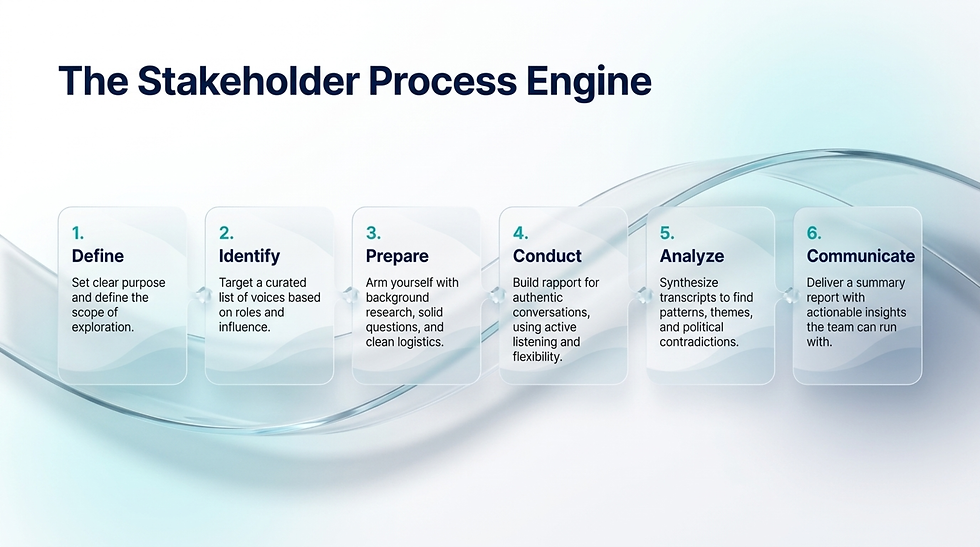
Six steps shape this conversation.
The step | What it produces |
Define objectives | A clear purpose and a defined scope |
Identify stakeholders | A targeted list of voices, with their roles and influence |
Prepare | Solid questions, background research, clean logistics |
Conduct | Authentic conversations and well-captured insights |
Analyze | Patterns, themes, contradictions, and a synthesized view |
Communicate | A summary report and actionable insights the team can run with |

Define the Objectives of the Interviews
Purpose
Clearly outline the goals of the stakeholder interviews. Typically, this involves understanding business objectives, gathering insights on project requirements, and identifying potential constraints and opportunities.
Scope
Determine the scope of the interviews, such as specific topics to cover or particular aspects of the project to explore.

Identify Key Stakeholders
Selection Criteria
Identify who the key stakeholders are. This usually includes business leaders, product managers, marketing teams, technical leads, and other individuals who have a vested interest in the project.
Roles and Influence
Understand each stakeholder's role and influence within the project. This helps in tailoring the interview questions to their specific perspective and expertise.

Prepare for the Interviews
Research Background
Gather background information about the stakeholders, their roles, and their previous involvement in similar projects. This preparation will help you ask relevant and informed questions.
Question Design
Develop a set of open-ended questions designed to elicit detailed insights. Cover: business goals (what are the primary business objectives for this project?), success criteria (how will success be measured?), user needs (what user needs or problems does the project aim to address?), challenges (what potential obstacles do you foresee?), and opportunities (what openings do you see for innovation or differentiation?).
Logistics
Schedule the interviews at convenient times for the stakeholders and ensure you have the necessary tools for recording and note-taking.

Conduct the Interviews
Build Rapport
Start with introductions and some light conversation to build rapport and make stakeholders comfortable.
Active Listening
Use active listening techniques, such as nodding, summarizing, and asking follow-up questions to show engagement and gather deeper insights.
Flexibility
Be flexible and allow the conversation to flow naturally. While it is important to cover your questions, be open to exploring new topics that may arise during the discussion.
Recording
Record the interviews (with permission) or take detailed notes to ensure you capture all relevant information accurately.

Analyze and Synthesize Insights
Transcription and Notes
Transcribe the recordings and consolidate your notes. Highlight key points, common themes, and unique insights.
Thematic Analysis
Group the information into themes or categories such as business goals, user needs, challenges, and opportunities.
Insight Synthesis
Synthesize the information to create a comprehensive understanding of the stakeholder perspectives. Look for patterns and contradictions to develop a well-rounded view.
Communicate Findings
Summary Report
Create a summary report that captures the key insights from the interviews. Include quotes, themes, and specific recommendations where applicable.
Presentation
Present the findings to the broader team and stakeholders. Use visual aids like slides or infographics to make the information more digestible.
Actionable Insights
Highlight actionable insights and how they will influence the project's direction. Ensure everyone understands how these insights will be integrated into the project plan.

Individual In-depth Interviews (IDI)
Stakeholders tell you what the business wants. Users tell you what the business actually needs. Different conversations, different rules. IDIs are where you sit one-on-one with a real human in your target audience and listen, properly, for an hour. They are the single highest-ROI hour in our discipline and most teams underuse them.
6 steps shape the IDI process.
The step | What it produces |
Define objectives | Clarity on what you are trying to learn |
Recruit participants | A diverse sample of real, representative users |
Prepare | An interview guide and clean logistics |
Conduct | Hours of honest user truth, properly captured |
Analyze | Personas, themes, behaviors, and contradictions |
Communicate | A story the whole team can rally around |

Define the Objectives of the Interviews
Purpose
Clearly articulate what you aim to learn from the in-depth interviews. Typically, this includes understanding user needs, wants, fears, motivations, and behaviors.
Scope
Determine the specific aspects of the user experience or product that you want to explore through the interviews.
Identify and Recruit Participants
Target Audience
Define the characteristics of your target audience, including demographics, psychographics, and behavioral traits.
Recruitment Criteria
Develop criteria for selecting participants to ensure a diverse and representative sample. Consider factors such as age, gender, occupation, tech-savviness, and relevant user experience.
Recruitment Methods
Use various methods to recruit participants, such as existing customer databases, social media, online panels, or recruitment agencies. Offer incentives if necessary to encourage participation.
Prepare for the Interviews
Interview Guide
Create an interview guide with open-ended questions designed to explore the key areas of interest. Cover: needs and wants (what are your needs and desires related to this product or service?), fears and frustrations (what challenges do you face when using similar products?), motivations (what motivates you to use this type of product?), and behaviors (describe how you typically use this product or service, your routines and habits).
Logistics
Schedule the interviews at convenient times for participants. Ensure you have a quiet, comfortable setting for conducting the interviews, whether in-person or online. Prepare recording devices or software to capture the conversation.

Conduct the Interviews
Build Rapport
Begin with introductions and light conversation to make participants comfortable and establish trust.
Open-Ended Questions
Ask open-ended questions to encourage detailed responses. Avoid leading questions that might bias the answers.
Active Listening
Use active listening techniques, such as nodding, summarizing, and asking probing questions to go deeper into participants' responses.
Flexibility
Allow the conversation to flow naturally. Be prepared to follow interesting tangents that may provide valuable insights.
Recording
Record the interviews (with permission) or take detailed notes to ensure you capture all relevant information accurately.
Analyze and Synthesize Insights
Transcription and Notes
Transcribe the recordings and consolidate your notes. Highlight key points, common themes, and unique insights.
Thematic Analysis
Group the information into themes or categories such as needs, wants, fears, motivations, and behaviors.
Insight Synthesis
Synthesize the information to create a comprehensive understanding of the user perspectives. Look for patterns and contradictions to develop a well-rounded view.
Communicate Findings
Summary Report
Create a summary report that captures the key insights from the interviews. Include quotes, themes, and specific recommendations where applicable.
Personas and User Journeys
Develop personas and user journey maps based on the insights gathered. These tools help visualize the user experience and guide design decisions.
Presentation
Present the findings to the broader team and stakeholders. Use visual aids like slides or infographics to make the information more digestible.
Actionable Insights
Highlight actionable insights and how they will influence the product's design and development. Ensure everyone understands how these insights will be integrated into the project plan.

Competitive Research
Stakeholders give you the why. Users give you the what. Competitive research gives you the so what. It is the discipline of looking at every other product in your space, taking notes, and finding the gaps your competitors have left for you. Skip it and you ship a copy of something already on the market. Worse, you ship a copy of something already failing.
6 steps shape the competitive research process.
The step | What it produces |
Define objectives | A focused scope: features, UX, pricing, positioning |
Identify competitors | Direct, indirect, and adjacent rivals worth watching |
Gather data | Features, UX patterns, market positioning, feedback, pricing |
Analyze findings | SWOT, trends, and your real competitive benchmark |
Spot differentiation | Gaps in the market your product can fill |
Communicate | A clear report and actionable recommendations |

Define the Objectives of Competitive Research
Purpose
Clearly state what you aim to achieve with competitive research. This typically includes understanding industry standards, benchmarking against competitors, and identifying opportunities for differentiation.
Scope
Determine the specific aspects of the product and market you want to explore, such as features, user experience, pricing, and market positioning.

Identify Key Competitors
Direct Competitors
Identify products or services that directly compete with your own. These are offerings that target the same user base and solve similar problems.
Indirect Competitors
Identify products or services that offer alternative solutions to the same problem or cater to a slightly different user base but are still relevant to consider.
Adjacent Competitors
Consider products or services in related markets that might influence user expectations or market trends.
Gather Data on Competitors
Feature Analysis
Compile a list of features offered by competitors. Create a comparison matrix to visualize how each competitor stacks up against your product.
User Experience (UX) Review
Analyze the user experience of competitors by using their products. Document the user journey, noting strengths, weaknesses, and standout elements.
Market Positioning
Research how competitors position themselves in the market. This includes their branding, messaging, target audience, and value propositions.
Customer Feedback
Review customer reviews, ratings, and feedback for competitor products on platforms like Amazon, Google Play, the App Store, and social media. Identify common praises and complaints.
Pricing Strategy
Analyze competitors' pricing models, including tiers, packages, and any freemium or trial options.

Analyze and Synthesize Findings
SWOT Analysis
Conduct a SWOT analysis (Strengths, Weaknesses, Opportunities, Threats) for each competitor. This helps in understanding their strategic positions and identifying gaps in the market.
Trend Analysis
Identify industry trends and patterns from the data collected. Look for emerging features, UX patterns, or market shifts that could influence your product strategy.
Benchmarking
Use the data to benchmark your product against competitors. Identify where your product excels, matches, or falls short compared to the competition.
Identify Opportunities for Differentiation
Gap Analysis
Identify gaps in the market where competitors may be lacking or not fully addressing user needs. These gaps represent opportunities for your product to stand out.
Unique Value Proposition
Based on the gaps identified, develop unique value propositions that highlight how your product offers superior solutions or unique features that competitors do not.
Innovative Features
Brainstorm potential features or improvements that could set your product apart from competitors. Focus on user needs and pain points that are not adequately addressed by current market offerings.

Communicate Findings
Summary Report
Create a detailed report summarizing the competitive research findings. Include comparison matrices, SWOT analyses, and key insights.
Present Findings
Present the findings to the team and stakeholders. Use visual aids like charts, graphs, and infographics to make the information accessible and engaging.
Actionable Recommendations
Highlight actionable recommendations based on the research. Explain how these insights should inform the product strategy, design decisions, and development priorities.

Putting it all Together
Research is the backbone of any successful product design. By conducting stakeholder interviews, individual in-depth interviews, and competitive research, you gather the critical insights that drive informed decisions throughout the design process. These three methods together let you align the product with business objectives, deeply understand user needs, and identify opportunities to stand out in a competitive market.
Three lenses.
Three sources of truth.
That's the research.
With this in hand, you are equipped to create designs that are both strategic and user-centered.
Next up, Part 3: where we take the raw truth and turn it into direction. Analysis time.
Read The Full Series
This is Part 2 of 5.
Part 1 | |
Part 2 | Research |
Part 3 | Analysis |
Part 4 | Low Fidelity Designs |
Part 5 | High Fidelity Designs |


Comments