How to Scale a UX Team Without Killing the Craft


Two Startups, Same Trajectory, Different Endings
Two startups, both with three designers, both with the same Series B raise, both expecting to triple headcount in the next eighteen months. They are on identical trajectories on paper. Their headcount slides look the same. Their hiring plans look the same. Their org charts even look the same.
Eighteen months later, the picture is wildly different. One company has a 35-person design organization that is shipping faster than it ever has, holding craft, retaining talent, and quietly becoming a recruiting magnet. The other has fired the head of design, the head of design fired the manager they hired, and the team has shrunk back to seven people, three of whom are quietly interviewing elsewhere.
Same starting point.
Same budget.
Same talent pool.
Different outcomes by an order of magnitude.
The difference was not luck.
It was that one team understood something the other did not: scaling a UX team is a completely different discipline from hiring more designers.

Most leaders confuse the two. They get budget for headcount, they post jobs, they fill seats, and they wonder six months later why the team feels worse than when it was smaller. The answer is not that they hired the wrong people. The answer is that they treated a complex organizational design problem like a procurement problem.
This guide is the playbook for treating it like the design problem it actually is. By the end you will know the five stages every UX org moves through, what breaks at each transition, the hiring plan that actually scales, how to build the design system before the wheels fall off, when career ladders become essential, the operating cadence that holds a big team together, famous examples of teams that scaled well (and badly), and the seven mistakes even experienced leaders keep making.
Let's get into it.


Part 1: What Scaling a UX Team Actually Means
Hiring more designers is the easy, visible part. It is also the smallest part of the job. The leaders who scale UX teams well spend most of their time on six other things, none of which show up on the hiring plan.
Career ladders So people grow inside the org instead of leaving to grow.
Design systems So craft holds across more people, more surfaces, and more speed.
Operating rhythms So a team of 30 stays coordinated and a team of 5 stays nimble.
Hiring pipelines So you can hire faster than you lose, and pick from a real pool.
Cross-functional muscle So design lands in product and engineering instead of being sealed off in its own room.
Culture So the team does not lose its soul as it gets bigger.
If you do not do these six things in parallel with hiring, the hiring breaks them. A team of 20 designers without career ladders is a team of 20 designers in active job search. A team without a design system is a team shipping inconsistent work at half their potential speed. A team without operating rhythm is a team in a daily Slack negotiation.
It doesn't make sense to hire smart people and tell them what to do. We hire smart people so they can tell us what to do. -- Steve Jobs
Scaling is the discipline of building the conditions where that quote remains true at any size.

Part 2: The Five Stages of a UX Organization
Every UX org moves through five distinct stages. Each one has its own needs, failure modes, and required moves. Confusing the stages is one of the most common, most expensive mistakes leaders make.
Stage 1: Solo (1 designer).
One person owns everything. Strategy, research, IC work, design system, accessibility, hiring, and probably the company website. The job is impossibly broad. The right hire is a Swiss-army knife with executive comfort. Founders often hire the wrong profile here: a portfolio star who has never worked alone in a company before. The portfolio star will quit in nine months.
Stage 2: Pair (2 to 5 designers).
The first real team. Now there are partners to bounce ideas off, but no manager. Everyone is still doing everything. The biggest risk at this stage is the team grows by adding generalists when what they need is one or two carefully placed specialists. Add a researcher. Or a content designer. Or a design technologist. Specialization at this stage compounds for years.

Stage 3: Pod (5 to 10 designers).
Real specialization starts. Pods form around product areas. The team needs its first dedicated manager or design lead. The biggest risk is hiring that manager too late and watching the most senior IC burn out trying to do both jobs. Promote from within only if the IC actually wants to manage. Hire from outside if nobody on the team has the appetite. Do not draft anyone into management.
Stage 4: Department (10 to 30 designers).
Multiple pods, multiple managers, a head of design. Now the operating rhythm matters more than the individual designers. Career ladders become essential or your senior people leave for clearer paths elsewhere. The design system needs a dedicated owner. Design ops becomes a role, not a side project. The biggest risk is the head of design getting pulled into individual project reviews and stopping doing org work, which is the work only they can do.
Stage 5: Organization (30+ designers).
VP or Chief Design Officer required. Multiple disciplines (UX, content, research, systems, ops, prototype) each with their own leader. The job is now to enable other leaders, not to lead the work directly. The biggest risk is treating it like Stage 4 with more people. It is not. The job has changed fundamentally.
Most companies stall at one of the transitions. The Stage 2 to Stage 3 transition kills teams that refuse to hire managers. The Stage 3 to Stage 4 transition kills teams that hire managers without ICs to manage. The Stage 4 to Stage 5 transition kills teams whose Head of Design cannot let go of project work.

Stage | Size | First time you really need... | Most common failure |
Solo | 1 | A Swiss-army designer with executive comfort | Hiring a portfolio star who has never worked alone |
Pair | 2 to 5 | One or two specialists, not more generalists | Hiring three more designers when you needed one researcher |
Pod | 5 to 10 | A dedicated manager or design lead | Burning out your senior IC by making them do both jobs |
Department | 10 to 30 | Career ladders, design ops, design system owner | Head of design doing project reviews instead of org work |
Organization | 30+ | Leaders of leaders, disciplines as functions | Treating it like Stage 4 with more people |

Part 3: The Three Things That Break at Every Transition
If you only remember one thing from this guide, remember this. The same three things break every time a UX team crosses a stage boundary. Watch for them and you will keep your transitions from blowing up.
Communication breaks first.
What worked in a Slack channel of three breaks in a Slack channel of fifteen. The default Slack-and-standup setup creates ambient noise instead of clarity. Each transition demands a new communication rhythm: standing meetings, written updates, structured reviews. Without it, the most senior designer becomes the bottleneck for every decision and everything slows down.
Onboarding breaks second.
When the team is small, new hires onboard by osmosis. They sit next to people, they pick things up. When the team gets bigger, osmosis stops working. New hires need actual onboarding materials, a buddy system, a 30-60-90 day plan, and a way to ask dumb questions safely. Teams that skip this lose half their hires within the first year.
Identity breaks third.
The team that was a tight band of generalists becomes a department with specialties. The culture shifts. The shared vocabulary fragments. The fun-Friday tradition collapses because nobody remembers why it started. Identity at scale has to be designed, not inherited. The Head of Design who does not consciously protect culture watches it dissolve.
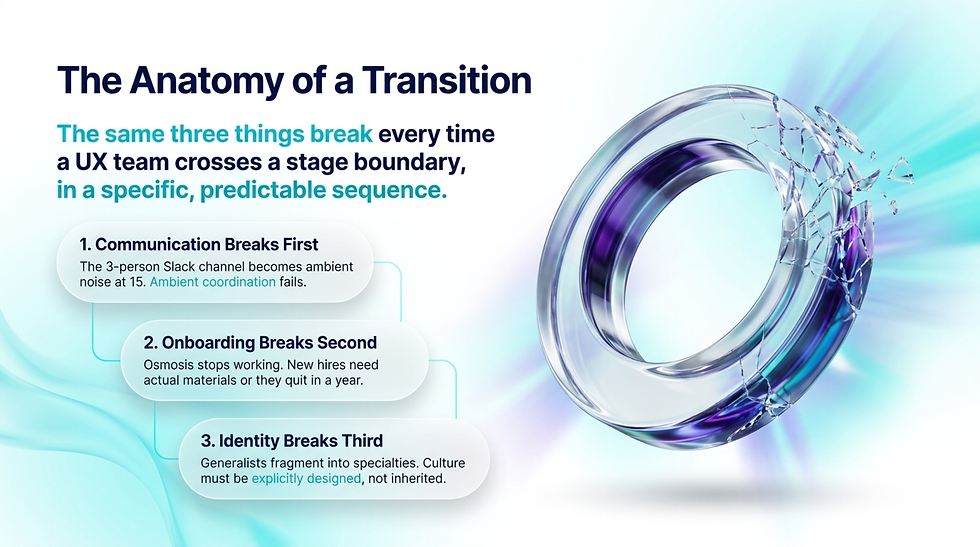
Notice the order.
Communication, onboarding, identity.
They fail in that sequence, usually three to six months apart.
By the time you notice identity is gone, you missed onboarding too.
By the time onboarding is broken, communication has been failing for a quarter.
Watch for the first signal and the rest is recoverable.

Part 4: The Hiring Plan That Actually Scales
The default hiring plan at most growing companies is "hire more product designers." This is the single most expensive mistake in UX scaling. A team of fifteen product designers is not a team. It is a generalist factory making slightly worse versions of the same screens over and over.

Real scale demands a mix. Here is the rough hiring sequence that works.
Headcount you are at | Next hire to make | Why this role next |
1 | Senior generalist designer | Partner for the solo, broad skill base |
2 to 3 | User researcher | Truth about the user, scales every other decision |
4 to 5 | Content designer | Words are interface, mostly broken at this stage |
6 to 7 | Design technologist or systems engineer | Components and front-end primitives |
8 to 10 | First design manager | Coaching and people leadership |
11 to 15 | Design ops lead | Operating rhythm, tooling, hiring pipeline |
16 to 20 | Principal designer or staff IC | Senior craft anchor, mentor for managers |
20 to 30 | Second design manager, dedicated design system team | Pod structure, system maturity |
30+ | Head of research, head of content, head of systems | Discipline leaders for the org |

Three principles run through this sequence.
First, alternate between ICs and supporting functions.
Two new product designers in a row is rarely the right move.
Second, hire the research function early.
Most teams hire research too late and pay for it in expensive product mistakes.
Third, do not hire your second manager until you have ten ICs.
Managers without enough people to manage either micromanage or get demoted.
Both outcomes are painful.

Part 5: Building the Design System Before You Need It
Every scaling design org eventually builds a design system. The teams that thrive build it on the way up. The teams that suffer build it after they realize they should have.
A design system is not a Figma library. It is a Figma library, plus a component library in code, plus the documentation that ties them together, plus the team that maintains them, plus the governance that decides what goes in. Build only the Figma library and you have built a sketchpad. Build all five and you have built leverage.

What a good design system saves you:
Speed Designers stop reinventing the same components. Engineering stops re-implementing them.
Consistency Your product looks like one product, not a collage.
Accessibility Bake it into the components and every downstream screen inherits it.
Onboarding New designers and engineers ramp on the system, not on every screen individually.
Quality at scale Junior designers shipping with the system produce senior-level output for the basics.

The single most common mistake in design system work is treating it as one person's side project. A real design system needs at least one full-time engineer, one full-time designer, and a third of a content designer's time. At larger scale it becomes its own pod. Underinvest at any stage and the system rots faster than the rest of the product moves.
Start the design system at Stage 2 (two to five designers).
Hire your first dedicated systems person around Stage 3 (five to ten).
Make it a dedicated team by Stage 4 (ten to thirty).
If you wait until somebody complains, you are already late.

Part 6: The Career Ladder Question
Around ten designers, you need a career ladder. Without one, your senior people leave for companies that have one. With a sloppy one, you create endless promotion arguments that distract from the work. Build it right and it becomes the quietest organizational engine in your team.
The shape of a good design career ladder:
Level | Ballpark Years in The Industry | What you do |
Junior Designer | 0 to 2 | Learning the craft. Owns small surfaces with support. |
Mid Designer | 2 to 5 | Owns features end-to-end. Reliable shipper. |
Senior Designer | 5 to 8 | Owns complex flows. Mentors others. Operates with significant autonomy. |
Staff Designer | 8 to 12 | Owns multi-quarter initiatives. Spans product areas. Sets standards. |
Principal Designer | 12+ | Operates at the company strategy level. Tackles ambiguity. The deepest practitioner in the room. |

Three critical decisions to make explicit on the ladder.
First, is the management track separate from the IC track?
It should be.
A senior IC and a manager should be peers in level and compensation, not one above the other.
Second, what does Staff mean at your company?
Most ladders muddle this.
Pick a definition (multi-quarter scope, cross-team impact, or system-level work) and write it down.
Third, can people switch tracks?
Yes, but with explicit conversations, not by accident.

Two pitfalls to avoid.
The first is making promotions feel arbitrary.
If two designers at the same level are doing very different work and one keeps getting promoted, the other will leave.
Be explicit about the criteria.
The second is making the ladder so detailed that nobody can read it.
A ladder is a tool, not a treaty.
If yours is 47 pages, nobody is using it.

Part 7: The Operating Cadence That Holds a Big Team Together
Small teams coordinate informally. They drift past each other in the kitchen, they ping each other on Slack, they pop into each other's screens. None of this scales. A team of twenty designers that runs on informal coordination is a team of twenty designers shipping at the pace of seven.

Here is the cadence that holds a real UX organization together.
Cadence | What happens | Who runs it |
Daily | Stand-ups within pods (15 min) | Pod leads |
Weekly | One-on-ones with manager, design review of in-flight work | Managers, with rotating designers presenting |
Bi-weekly | Cross-pod critique (open to whole team) | Senior IC or design lead |
Monthly | Design all-hands, retro, social ritual | Head of design |
Quarterly | Planning, OKR review, career check-ins | Managers and head of design |
Yearly | Compensation review, career conversations, team vision setting | Head of design with HR and leadership |
Three things to protect on this cadence.
Critique must be open to everyone, not gated by pod or seniority.
Otherwise the team learns by silo and quality drifts.
Career conversations need to happen quarterly, not annually.
Yearly conversations are too sparse to course-correct.
And the social ritual matters more than leadership thinks it does.
Lose it and the team feels like coworkers instead of teammates.

Part 8: Real Examples of UX Scaling Done Well (And Badly)
Theory is cheap. Watching real companies scale teaches you more than any framework.
1. Airbnb's design-led scaling.
From a handful of designers to hundreds, Airbnb invested heavily in the design system (Design Language System), in design ops, and in having designers operate as cofounders of product. They got the early scaling right. They struggled later when the org got too big to keep that founder-feel, and the IPO years saw turnover at the top. Lesson: scaling craft is one problem. Scaling identity is a separate, harder problem.
2. Spotify and the Squad / Tribe model.
Spotify popularized the squads-and-tribes structure: small cross-functional squads, grouped into tribes by product area, with chapters for disciplines. Designers belong to squads functionally but to design chapters professionally. It is messy on paper. It worked because Spotify invested in the chapter leads (who looked after design careers) as much as the squad leads (who looked after shipping). Lesson: matrix organizations require strong functional leadership or they collapse into pure squad chaos.

3. Apple's HI team.
Smaller than most outsiders assume. Tight integration with engineering. Research treated as a strategic resource. Apple does not scale by adding designers. Apple scales by being deliberate about who is allowed in the room. Lesson: not every company should scale headcount. Some should scale standards instead.
4. Disney's Imagineering.
A model where storytellers, architects, engineers, and designers are peers, organized around projects not disciplines. The scale is enormous, the projects span years, and craft holds because the project structure is the org structure. Lesson: when the work is multi-year, the org chart should look more like a portfolio of teams than a tree of departments.
5. The classic failure pattern: hiring a Head of Design too late.
Many startups wait until they have 12 designers in chaos to hire a Head of Design. The new head then has to fix the org, change the system, and rebuild the culture all at once. Most fail. Lesson: hire the Head of Design before you have the chaos, not because of it. The right time is around eight to ten designers, not twenty.

Part 9: Seven Mistakes Even Smart Design Leaders Make
These show up at teams that should know better. Pattern-match against them ruthlessly.
Mistake 1: Scaling the IC ladder without managers.
Twenty senior designers and one manager equals one exhausted manager and twenty designers who are not growing. Hire managers in proportion. The healthy ratio is roughly one manager per six to eight ICs at scale, slightly tighter early.
Mistake 2: Scaling managers without ICs.
The reverse failure. Four managers and six ICs means too much management, too little doing. Managers without enough people to manage either micromanage or invent process for sport. Both kill momentum.
Mistake 3: Forgetting design ops.
Design ops feels invisible until you do not have it. Then you notice the team spending two days a week on logistics, tooling, and hiring coordination that should have been somebody else's job. Hire design ops by Stage 3. Earlier is fine. Later is painful.

Mistake 4: Letting the design system fall behind the product.
If your product is shipping faster than the design system can keep up, designers start working around the system. Within a quarter, the system is decoration. Either staff the system properly or slow the product. There is no third option.
Mistake 5: Mixing reporting lines too early.
Some leaders dotted-line their designers to PMs at Stage 2 in the name of cross-functional alignment. It usually means the designer ends up reporting to whichever PM yells loudest. Keep reporting clean until at least Stage 4. After that, matrix carefully.
Mistake 6: Not protecting time for craft.
As teams scale, meeting load creeps up and design time shrinks. The Head of Design who lets this happen produces an org of project managers, not designers. Hold the line. Block calendar time for craft. Defend it like a budget.
Mistake 7: Optimizing for the org chart instead of the outcome.
Org chart redesigns feel productive. They are usually not. Most reorgs solve one problem and create three new ones. Before every reorg, ask: what outcome is impossible under the current structure that becomes possible under the new one? If the answer is vague, do not reorg.

Looks like good scaling | Actually is good scaling |
Big hiring announcements | Steady, well-sequenced hires |
Impressive org chart slides | Designers shipping faster than last quarter |
A new design system launched | A design system that the team actually uses |
A Head of Design hired | A Head of Design empowered to make org decisions |
More meetings | Fewer, better meetings |
A bigger team | A team where senior designers want to stay |

Quick Answers to the Questions Every Design Leader Asks
When do we need a Head of Design?
Around eight to ten designers, when individual coaching, hiring coordination, and cross-functional politics all hit critical mass at once. Wait until twenty and you are hiring somebody to clean up a mess that was preventable.
When do we need design ops?
By the time you have ten designers, you have already needed it for six months. Design ops pays for itself within a quarter by removing logistical drag from your most expensive designers. The earlier you can justify the hire, the more leverage it produces.
What is the right designer-to-PM ratio?
Roughly one designer per PM at most companies, with some flex. Below 0.5 designers per PM and the design function becomes a service desk. Above 1.5 designers per PM and the designers start designing without product strategy. Aim for parity.

Should designers report to product or directly to a head of design?
To a head of design, with dotted lines to product. Designers report functionally to the discipline that knows how to evaluate their work, coach them, and grow their careers. They take projects from product. Mixing those two breaks both.
When do we hire our first manager?
Around five to seven designers, when one-on-ones, project oversight, and career conversations stop fitting in one person's calendar. Hire from inside if somebody on the team genuinely wants to manage. Hire from outside if not. Never draft.
How do we keep craft alive at scale?
Three habits. Critique that includes the most senior people regularly. Promotions that require demonstrated craft, not just delivery. A Head of Design who still reviews work in detail at least monthly. Craft dies quietly when nobody senior is looking. Keep looking.

Putting It All Together
Scaling a UX team is not a hiring problem. It is an organizational design problem disguised as a hiring problem.
Know which stage you are in. Watch for the three things that break at every transition. Hire in the right sequence, not just more of the same role. Build the design system before you need it. Put a career ladder in place before your seniors leave. Run the operating cadence that holds the team together. Steal from the teams that scaled well. Avoid the seven mistakes that derail even smart leaders. Keep craft alive by looking at the work.

Do all of this and your team grows into the company it could be. Skip any of it and you join the long list of design organizations that doubled in size and halved in quality.
The best design organizations at scale do not feel like big organizations. They feel like a constellation of small, strong teams holding the same standard. That feeling is not an accident. It is engineered.
Build the conditions and the team builds itself.
Go scale something worth scaling.


Comments