How to Hire a UX Lead Who Actually Moves the Needle


The $400K Decision You Are About to Make
Hiring a UX lead is one of the most expensive bets you will place in a calendar year. Add up salary, equity, ramp time, opportunity cost, and the team morale hit when it goes sideways, and the wrong hire costs roughly $400K.
The right one pays for itself in the first feature they ship.
Most UX lead hires fail. Not because of bad candidates, but because of vague job descriptions, interviewers who do not know what they are looking for, and rushed offers made to whoever interviewed best. This guide fixes all of that.
What follows is the playbook I use when teams ask me how to make this hire well. It covers what the role actually is, what to look for, what to walk away from, how to interview, how to test for the real signal, and how to set your new lead up to win once they sign.
No fluff.
No filler.
No buzzwords.
What This Guide Covers
The role beneath the title.
Why most hires fail.
The seven traits that actually predict success.
The interview process that filters for outcomes, not vibes.
Red flags you cannot unsee.
The 80 / 20 principle every great UX lead uses silently.
What this hire actually costs.
The mistakes even smart teams make.
BONUS: And how to set your new hire up so they do not quit in six months.
Read it once.
Then come back when you start drafting the job description.
You will want to read it for a second time.
It will be waiting here for you.

Part 1: The Real Job (Not What the Job Description Says)
Most job descriptions for UX leads read like a wishlist somebody copied off LinkedIn. They list every tool ever invented, every methodology ever named, every soft skill known to recruitment. They tell you nothing about the actual job.
Here is the actual job.
A UX lead wears five hats, and the hats are not equal in weight. They shift depending on the day, the company stage, and the team around them. If you do not know which hat you need most, you cannot hire well.

The Five Hats a UX Lead Wears
1. The translator
They take design ideas and turn them into language the CFO understands. They take business ideas and turn them into design briefs the team can act on. This is the hat they wear most often. It is also the hat most candidates underestimate.
2. The strategist
They decide what the team works on next, what they say no to, and how design decisions ladder up to business outcomes. A UX lead without a strategy is just an art director with a Slack channel.
3. The coach
They mentor designers, give feedback that sticks, run critique sessions that do not turn into ego matches, and grow the next generation. Great UX leads make their team better than they were at hire. The mediocre ones make the team dependent on them.
4. The maker
They still ship. Not every screen, but the hardest ones. The high-stakes prototype that goes in front of the board. A UX lead who has not opened Figma in two years has quietly stopped being credible to their own team.
5. The diplomat
They navigate engineering pushback, product manager priorities, executive whims, and the politics of cross-functional work without burning bridges or losing their voice. This is the hat that determines whether they last 18 months or 5 years.
If your job description does not signal which of these five hats matter most for the current moment, you will attract the wrong candidates and waste 90 days of interviewing.
Quick Reference Chart
Hat | Done well | Done poorly |
The Translator | Pitches design proposals in CFO language: cost, time, risk, lift | Talks heuristics in meetings where nobody knows what affordances are |
The Strategist | Walks in with a six-month roadmap and the rationale behind it | Waits for the PM to hand them a backlog |
The Coach | Designers on the team get promoted faster than peers in other orgs | Designers feel managed, not mentored |
The Maker | Ships the hardest prototype in the company twice a year | Has not touched Figma in 18 months |
The Diplomat | Resolves engineering conflicts before they reach the CTO | Goes around engineering and the conflict gets ugly |

Part 2: Why Most UX Lead Hires Fail (And It Is Not What You Think)
You will read a lot of articles that blame failed UX hires on poor interviewing, weak portfolios, or culture fit. Those are real. They are not the root cause.
The root cause is almost always a mismatch between the stage of the product and the type of lead the company hired.
A company at the zero-to-one stage needs a maker who can strategize. A company at scale needs a strategist who can coach. A company recovering from an acquisition needs a diplomat who can rebuild. These are different humans. Confusing them is the most common, most expensive hiring mistake in this discipline.

Three Stages, Three Different Leads
Look at three of the most-discussed design hires in tech history and the pattern is clear.
When Airbnb was scaling from a scrappy startup into a public company, Brian Chesky and Joe Gebbia leaned on design leaders who could translate their design-first culture into something that scaled across thousands of employees. They needed a strategist with diplomatic chops. Not a maker.
When early Apple needed somebody to invent the iPhone experience, Steve Jobs leaned on Jony Ive, a maker so deep in the craft that he was effectively a design organism with executive authority. A pure strategist would have killed the project in five board meetings.
When Disney bought Pixar, the integration would have failed if Ed Catmull had hired a process-driven design manager. The leadership style that worked was protective, cultural, almost philosophical. A diplomat first, a maker second.
Three companies. Three different hires. Three correct decisions. The trait that mattered most was not skill level. It was the alignment between the moment and the person.

Stage | What you need | What you do not need |
Zero to one (pre product-market fit) | A maker with strategic instinct | A senior manager who has not designed in five years |
Scaling (10 to 100 employees) | A strategist who can coach | A solo virtuoso who avoids meetings |
Mature (100+) | A diplomat with strong process | A passionate hands-on designer with no patience for ops |
Post-acquisition or transformation | A diplomat with cultural intuition | Anyone obsessed with their own brand of design |

Five Real Hiring Scenarios (And What Each One Actually Needs)
The stage table is useful at the macro level. In practice, the moment is more specific. Here are five scenarios that come up constantly, and what each one really needs.
Scenario 1: The Series A founder hiring their first UX lead.
You have shipped product-market fit. You have two designers. You are about to triple. You need a maker who has built design orgs from scratch before, not somebody from a 500-person company who has only ever managed. The instinct is to hire experience. The right instinct is to hire scrappiness. Look for somebody who has been the first design hire somewhere else and lived to tell the story.
Scenario 2: The Series C product hitting a retention wall.
Your dashboard is everything. Your retention is everything. Your users are not loving the experience and the data shows it. You need a strategist with data fluency, not a portfolio star. The interview should be 60% about how they read funnels and 40% about how they design. If they cannot read a retention chart, they cannot fix one.
Scenario 3: The post-acquisition integration.
You acquired a company. You have two design orgs. You have two design systems. You have two opinionated leaders. You do not need somebody who has "strong design opinions." You need somebody who can run a six-month cultural integration without anybody quitting. The interview should focus almost entirely on diplomacy. Their portfolio is almost irrelevant.
Scenario 4: The regulated fintech or health-tech.
Every screen has compliance implications. The user is anxious by default. The brand has to convey trust without feeling sterile. You need a UX lead who has shipped in a regulated environment before. They should be able to talk about constraints with energy, not resentment. Constraint-hunters thrive here. Constraint-haters quit in eighteen months.
Scenario 5: The AI-native startup.
Your interface is half-product, half-conversation. The product manager and the model team are both designing without realizing it. You need a UX lead who has been close to AI products before and understands that the model is part of the UI. Somebody who has only designed traditional SaaS will spend their first six months catching up while the team passes them by.
If your situation is not on this list, find the closest match and reason from there. The principle is the same: the moment dictates the hire, not the title.

Part 3: The Seven Traits That Actually Predict Success
Forget the trait lists every other article gives you. They are usually right but not actionable. Here are the seven traits that actually predict whether a UX lead will succeed in your specific role, and how to spot each one in a single interview.
1. Strategic vision over visual taste
Visual taste is table stakes. You can spot it in a portfolio in 60 seconds. Strategic vision is harder. It shows up when you ask a candidate "what would you not build, and why?" The mediocre candidate lists tactical pet peeves. The exceptional one tells you what they would deprioritize at the company level and how they would defend that call to a CEO. If they cannot do the second one, they are not yet a lead. They might be ready in two years. Not today.
2. Translator instincts
Watch how they speak about their work. If they default to design jargon, that is who they will be in your boardroom too. Affordances, heuristics, signifiers, gulf of execution. These are real terms, but if the candidate cannot translate them into revenue, retention, risk, and time, they will struggle to influence anyone outside the design team. Test this by asking them to explain their last big win to "an investor who has never used software." The great ones smile and do it cleanly. The rest stumble.
3. Player-coach balance
Ask: when was the last time you opened Figma to actually design something, not just review it?
Anything more than three months is a yellow flag for an early or mid-stage company.
They have drifted into pure management and quietly lost the ability to model the craft.
Then ask the inverse: when did you last give a designer feedback that made them visibly better?
If they cannot remember, they have not really been coaching.
Both halves of the answer matter.
4. The data backbone
A great UX lead does not need to be a statistician. They should have an intuitive grasp of what numbers move when their work ships. Ask: what three numbers did your last project actually move? If they cannot answer cleanly, they have not been operating at the lead level. They have been shipping pixels and hoping. That is not what you are paying $300K for.
5. Calm under conflict
UX leads sit at the intersection of product, engineering, research, marketing, and executives. They will be argued with constantly. Test this directly: tell them about a real disagreement your team has right now and ask how they would handle it. Watch for two failure modes. Mode one is pure agreement, which means they will fold under pressure. Mode two is aggressive certainty, which means they will burn relationships by month two. The answer you want sounds like: "I would want to understand more about why each side cares before I take a position." That is the diplomat speaking.
6. Adaptive curiosity
The best UX leads read business books, not just design books. They follow earnings calls in your industry. They know what your competitors are launching next quarter. Ask: what did you read last month that changed how you think about our space? If they default to a design publication, they are still in their lane. If they cite something from your industry, that is a green flag the size of a billboard.
7. Outcome ownership
This is the trait that separates exceptional UX leads from very good ones. Exceptional ones say "I own the conversion rate on this funnel" without flinching. Very good ones say "design supports the product team that owns the funnel." Both can be successful. The first one becomes a partner to the CEO. The second one stays a department head. Which you want depends on what kind of company you are building.
Looks like a UX lead | Actually Is a UX lead |
Beautiful portfolio | Portfolio with measurable outcomes |
Talks fluently about heuristics | Talks fluently about revenue and retention |
Has managed designers | Has grown designers into the next level |
Strong opinions on design tools | Strong opinions on business strategy |
Hands off, calls it strategic | Still ships the hardest thing once a year |
Generic conflict-resolution platitudes | Specific stories of disagreements handled well |
Reads design blogs | Reads earnings calls in your industry |

Part 4: Before You Post the Job, Define the Hire
The single highest-leverage hour you will spend in this process is the one before you write the job description. Most teams skip it. The result is six months of bad interviews.
Sit with your co-founders, your CTO, and your head of product. Answer these seven questions out loud.
Where is your product on the stage curve?
Early concept, post product-market fit, scaling, or mature. Each one calls for a different lead. Be honest about where you actually are, not where the deck says you are.
What is the team you are handing them?
Zero designers, two, eight, twenty.
The job is wildly different at each size.
A lead who thrives at zero often suffocates at twenty.
A lead who shines at twenty cannot stomach building from zero.
What is the single biggest UX pain in the business right now?
Onboarding conversion, retention drop-off, internal tool chaos, mobile parity, accessibility, AI integration. The lead you want is the one whose last 12 months map closely to that exact pain.
Who will they report to?
A CPO, CEO, head of product, or CTO. The relationship determines the kind of leader who will thrive. A diplomatic CPO needs a maker. A maker CTO needs a translator. Pair the personality with the boss, not just the org chart.
How much hands-on design do you expect?
Be specific. 80% hands-on with 20% strategy. 50/50. 10/90. Most teams say "balanced" and mean different things. Write the percentage down and put it in the job description.
What does success in year one look like?
Not vague. Specific. Three projects shipped, two designers hired, a design system in place, a research practice stood up. Write the year-one scorecard before you write the job description. Then build the interview around the scorecard.
What is your culture, honestly?
Fast-and-loose, methodical-and-careful, debate-heavy, harmony-prioritizing, distributed-async, in-office-daily. The lead has to fit the culture you actually have, not the one in the handbook.
Answer these seven questions clearly and the job description writes itself. The interview will be sharper. The eventual hire will know what they signed up for. Skip the questions and you are betting $400K on vibes.

Part 5: The Interview Process That Actually Works
There is a version of the UX lead interview that has become standard in tech. It is mostly broken. The candidate gives a portfolio talk, a few people ask the same three questions, then somebody decides "they had a good vibe" and the offer goes out.
Here is the version that works.
Stage 1: The Strategic Conversation (45 minutes)
No portfolio.
No slides.
Just a conversation with whoever will be their boss.
The goal is to assess strategic instinct, business literacy, and whether they have actually been operating at the lead level.
3 questions do most of the work.
What is the most expensive design mistake you have prevented in the last 12 months?
Great leads have a story ready. Less great ones talk about design wins. The best ones talk about what they killed.
Walk me through how you would think about our product in the first 30 days.
Listen for them noticing what you have not told them. Did they research your business? Do they have a hypothesis? Or are they fishing for a brief?
What is the question you wish I had asked you?
This reveals what they prioritize. If they pivot to talk about themselves, they are still a candidate. If they pivot to a sharp question about your team or your product, they are already operating like a partner.
Stage 2: The Portfolio Walk (60 minutes)
Now the portfolio.
Not as a presentation.
As a working session.
Ask the candidate to pick one project they led, not contributed to. The distinction matters.
Then ask 4 questions.
What were you trying to prove with this project?
Tests strategic clarity.
Who pushed back on you, and how did you handle it?
Tests diplomacy and conflict tolerance.
What did you ship that you wish you had not?
Tests self-awareness. The candidate who has never regretted a ship is either lying or has not shipped enough.
What did this project move?
Tests outcome literacy.
If they cannot answer these four with specifics, they are not yet a lead.
Stage 3: The Strategic Exercise (Take-home, 5 to 8 hours)
Not a free design.
Never a free design.
The strategic exercise is a one-page memo on a business question.
For example: our retention drops 30% between week one and week four. You have a $500K budget and a team of three designers for one quarter. Write a one-page memo on what you would do and why.
You are looking at how they think, not what they design. Reading their thinking will tell you more in 30 minutes than three rounds of behavioral questions ever will.
Stage 4: The Cross-Functional Panel (90 minutes)
Bring in two product managers, an engineer, and a researcher. Let them grill the candidate together. Watch the dynamics. The great UX lead disagrees with at least one of them politely. They never agree with everyone in the room.
Stage 5: The Behavioral Deep Dive (45 minutes)
Now ask the questions that reveal patterns over time.
Tell me about a designer you grew into a manager.
Tell me about a time you were overruled and you turned out to be right.
Tell me about a hire you should not have made.
Look for specific names, dates, and reflections. Not generic narratives.
Stage 6: The Reverse Interview (30 minutes)
Tell the candidate this is their hour to interview you. The best leads use it. They ask sharp questions about runway, executive support, design org maturity, and how they will be measured. The weaker candidates use it to talk about their interest in your mission. That is fine. The first group is the one you want.
Stage 7: References That Go Deeper Than HR
The standard "would you rehire them" reference is useless. Everyone gets a yes.
Ask 3 questions instead:
What was hard for them in this role?
If the answer is "nothing," the reference is being polite. Press for specifics.
What kind of team do they thrive in?
Listen for cultural fit signals.
What would I be hiring them away from if I made an offer?
If the answer is "a great situation, they are loved here," that is a signal. If the answer is "they are ready for a bigger problem," that is a stronger signal.
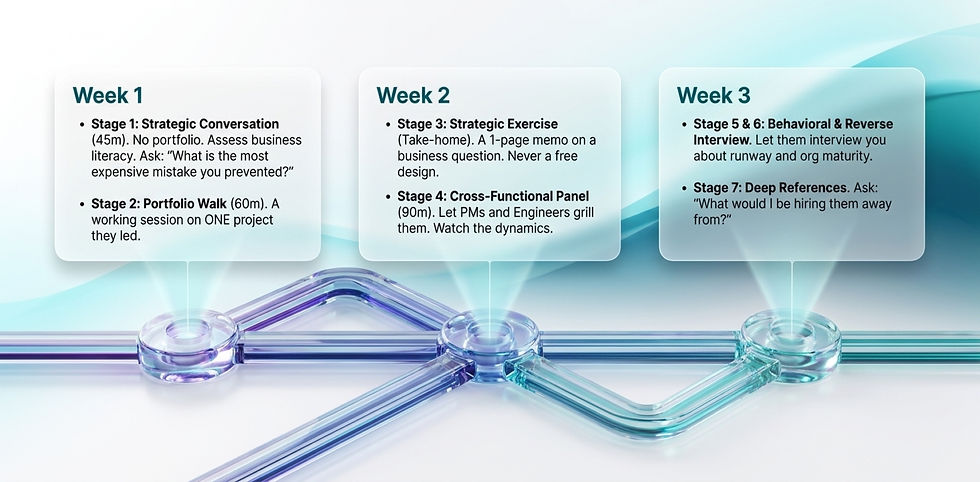
A Sample Three-Week Hiring Schedule
Most companies stretch this hire across four to six months because nobody owns the timeline. Here is what a tight, three-week loop looks like for a senior candidate. Adjust by a week if you are running multiple finalists in parallel.
Week | What happens | Who is involved | Approx. time |
Week 1 | Resume screen, recruiter call, Stage 1 strategic conversation, Stage 2 portfolio walk | Hiring manager, recruiter | 3 to 4 hours |
Week 2 | Take-home strategic exercise (Stage 3), Stage 4 cross-functional panel | Hiring manager, 2 PMs, 1 engineer, 1 researcher | 4 to 5 hours |
Week 3 | Stage 5 behavioral, Stage 6 reverse interview, Stage 7 references, debrief, offer | Hiring manager, executive sponsor, finance for offer math | 3 to 4 hours |
Three things to protect on this timeline.
Do not skip the take-home (Stage 3) just because the candidate is busy.
Do not move references to last (Stage 7) and treat them as a formality.
Do not let the debrief slip more than 48 hours after the last interview.
Memories blur fast.
The signal you collected on day one is sharpest on day two.

Part 6: Red Flags You Cannot Unsee
Some red flags can be coached. Others cannot. Here is the list I have learned, sometimes painfully, to walk away from.
The tool fetish
The candidate keeps coming back to Figma plugins, prototyping methodologies, and design tooling preferences. Tools are not the job. If they cannot get past tools in a 45-minute conversation, they are not yet senior.
The pixel perfectionist
Beautiful portfolio, every screen pristine, every transition micro-detailed. Ask them what they have shipped in the last quarter. If the answer is "we are still iterating," that is the entire problem. Polish at the cost of velocity is a junior trait, not a senior one.
The strategic absentee
Big-picture talk, lots of frameworks, transformation, vision, culture. Ask them to walk you through a working day. If they cannot describe the actual texture of design work, they have drifted too far from the craft to lead a team.
The portfolio thief
Their portfolio looks great until you ask what specifically they did on this project.
The answer is vague.
"I led the team."
"I drove the strategy."
"I oversaw the design."
Press for specifics.
The honest senior says "I designed screens 3, 7, and 11, I drove the IA, my designer Sarah did the visual system."
The dishonest senior keeps deflecting.
The defensive responder
Push back on one of their design decisions politely. Watch what happens. The great leads engage. They consider. They sometimes change their mind in real time. The bad ones get defensive, double down, or pivot to credentials. The defensive responder will not survive in your boardroom either.
The lone wolf
Listen for the pronouns. If everything is "I" with no "we," ask about the team they worked with. If they cannot name designers they grew, that is a yellow flag for a manager hire. Lone wolves can be brilliant individual contributors. They are usually terrible leads.
The titles collector
Senior, Principal, Staff, Lead, Director, all in five years.
That is not career progression.
That is title chasing.
A real lead has spent at least 18 to 24 months at a level before stepping up.
If they have not, they have not yet seen the downstream consequences of their own decisions.
Green flag | Red flag |
Names designers they grew | Names companies they worked at |
Has killed projects on purpose | Has only great wins in their portfolio |
Disagrees politely in the interview | Agrees with everything you say |
Asks how they will be measured | Asks about title and reporting structure |
Cites business outcomes | Cites design tools |
Has regrets they have reflected on | Has only positive stories |
Reads outside their lane | Stays inside their lane |

Part 7: The 80/20 Principle of UX Leadership
This is the principle every great UX lead silently applies. Few articulate it. 80% of the outcome from any UX function comes from 20% of the decisions the lead makes. The job is to identify the 20% and protect it ruthlessly.
In any product, three to five flows do most of the work. Onboarding. The core action. The upgrade moment. The resubscribe moment. One or two others. A great UX lead spends 80% of their attention on the 20% of surfaces that drive the business. They let the rest run on existing patterns and design system defaults.
A mediocre lead spreads attention evenly across every screen. They lose. The product ships slower. The team burns out. The metric does not move.
The signal that a candidate understands this principle is how they answer the question "what would you not work on?" The great ones answer instantly. They know what to ignore. The mediocre ones cannot bring themselves to deprioritize anything.
If a candidate does not get this principle, the rest of the playbook does not matter.

What This Hire Actually Costs
If you are budgeting for a UX lead based on old numbers, you are about to lose your top three candidates in the offer stage. Here is the honest compensation landscape for senior UX leadership today.
Total compensation for a strong UX lead at a venture-backed company in a major US market generally lands between $250K and $500K all-in, depending on stage, location, and the maturity of the role. That is base salary plus equity plus sign-on. Big tech and frontier AI labs go higher. Early-stage startups go lower on base but heavier on equity.
A few things to know going in.
Company Stage | Realistic Base Salary | Equity considerations | What it signals to the candidate |
Seed to Series A | $170K to $230K base | Meaningful equity (0.5% to 2%) | You are betting on us, we are betting on you |
Series B to C | $220K to $320K base | Solid equity (0.2% to 0.7%) | We are scaling, we need leverage |
Series D to pre-IPO | $280K to $400K base | Late-stage equity, possibly liquidity | We pay for senior craft |
Public or big tech | $320K to $500K+ total | Significant RSUs | Top of the market, we expect impact |
Beyond the headline number, what closes great candidates is rarely the base salary. It is the things around it. The reporting line. The hiring authority. The scope. The executive sponsorship. The clarity of the year-one scorecard. If you compete only on cash, you will lose to companies that compete on context.
Three negotiation moves that actually matter. Offer a sign-on bonus that covers the equity the candidate is walking away from at their current job. Build in a six-month milestone bonus tied to the year-one scorecard you wrote in Part 4. Be explicit about the equity refresh cadence in year two. Candidates who have done this before notice when you address all three. The ones who notice are usually the ones you want.

Part 8: After the Hire, Set Them Up to Win
Most of what kills new UX leads is not the interview. It is what happens in the first 90 days. Companies hire well and onboard badly. The result is the lead quits in 18 months and the team blames "fit."
Here is what actually sets a new UX lead up to win.
Give them political air cover for the first 90 days.
They will need to push back on things. Make sure the executive who hired them is publicly visible in their corner during this window. Without air cover, they spend 90 days fighting battles they do not yet have credibility to win.
Resist the urge to assign three crises at once.
Founders love to do this. "We need help on onboarding and the dashboard and the AI feature and please also fix the mobile app." Pick one. Let them ship it. Then add the next.
Define success in writing, in advance.
Year-one scorecard. Three to five outcomes. Reviewed quarterly. If you cannot define success in writing, you cannot fairly judge them later.
Give them hiring authority within reason.
If they cannot pick their first two designers, they are not really a lead. They are an art director with a title.
Do not put them in a basement.
UX leads need a seat at the senior product table. If they are reporting up through five layers, they will atrophy fast. The org chart is part of the job offer.
Trust their no.
A new UX lead will start saying no to things in month three. Some of those nos will sting. Trust them. If you hired well, the no is a feature, not a bug.
BONUS
Part 9: Build the Team Around Them, Not the Other Way Around
Hiring the UX lead is the first move.
The second move is building a team they can do their best work with.
The order matters.
A great lead with the wrong team will leave inside two years.
The basic shape of a healthy UX team has five roles, even if some are part-time at small companies.
Role | Description |
Senior interaction designer | Ships the hardest screens. |
User researcher | Owns the truth about the user. |
Content designer | Keeps the language tight. |
Design systems engineer or Technical designer | Owns the components and the front-end primitives. |
Lead designer | Connects all of them to the business. |
You do not need all five on day one.
The lead needs to be able to hire toward this shape over 12 to 18 months.
If your hiring plan only includes "designers," you have already lost. Specificity is the unlock.
Look at the design organizations that have produced legendary products. Apple's HI team historically had a tight pairing of interaction designers and software engineers, with research treated as a strategic resource. Airbnb invested heavily in design systems early, which is what let them ship at the pace they did. Disney's Imagineering ran a model where storytellers, architects, and engineers were peers, not in a hierarchy. The pattern across all three is that great UX leadership built teams of complements, not clones.

Five Hiring Mistakes Even Smart Teams Make
Even teams that follow most of this playbook still find ways to lose. These are the five mistakes that show up the most, even at companies that should know better.
Mistake 1: Hiring on portfolio alone.
The portfolio shows you what they have made. It does not show you whether they led, whether they shipped, or whether they would do it again the same way. A pretty portfolio with no decision-making story behind it is decoration. Decoration is not strategy.
Mistake 2: Skipping the strategic exercise to be respectful of the candidate's time.
Some candidates push back on take-home work. That is fair, but the strategic exercise is the single most predictive signal you will get. If you skip it, you are flying blind on the trait that matters most. Pay them for the time if needed. Do not skip it.
Mistake 3: Letting the loudest interviewer drive the decision.
In most debriefs, one person speaks first and most. That person sets the frame and the others adjust. Run silent written debriefs first, then discuss. Force every interviewer to commit a rating and a paragraph before they hear anyone else.
Mistake 4: Negotiating from a position of need.
If you wait until you are six months into a search to make an offer, your negotiating posture is desperate and the candidate can read it. Start the search earlier than you think you need to. Run two finalists in parallel through the last round. Always have a walk-away point.
Mistake 5: Mistaking energy for impact.
Some candidates interview beautifully. They are charismatic, articulate, full of vision. Then they ship nothing. The way to defend against this is the strategic exercise, the portfolio walk with specifics, and the references with sharper questions. If their energy is high and their specifics are vague, they are a presenter, not a leader.

Quick Answers to the Questions Every Hiring Manager Asks
How long should the search take?
A focused, well-run search takes 8 to 12 weeks from kickoff to signed offer. If you are past four months, something is broken in your process, not in the market.
Should we use an executive recruiter?
For Series B and above, yes. A good recruiter can cut your search by 4 to 6 weeks and surface candidates who are not publicly looking. Below Series B, founders usually run it themselves. The expensive part of a recruiter is justified when the cost of a slow hire is higher than the fee.
Should we hire a fractional or interim UX lead first?
Often yes, especially if you are not sure what kind of lead you need. A two-month fractional engagement with a senior practitioner can clarify your scorecard, surface the real problems, and even help you write the job description.
It is one of the highest-ROI moves in early-stage design hiring.
What if we find an amazing candidate in week one?
Run the full process anyway. If they are truly amazing, they will not be intimidated by it. They will respect that you take the hire seriously. If they pull out because the process is rigorous, they were not the right hire.
How do we know if the hire worked, six months in?
Three signals. The team is shipping more and arguing less. The CEO mentions design in board updates without prompting. At least one designer on the team has visibly leveled up. If you see all three, the hire worked. If you see none of them, course-correct before month nine, not month eighteen.

Putting It All Together
If you take one thing away from this playbook, take this: the hire is upstream of everything.
Define the stage.
Map the role to the moment.
Hire for the seven traits.
Run the interview process that filters for outcomes.
Walk away from the red flags.
Apply the 80 / 20 principle.
Pay competitively.
Onboard with air cover.
Build the team in their shape.
Do all of this and you will have a UX lead who pays for themselves in the first feature they ship. Skip any of it and you will be back here in 18 months reading another version of the same article.
The best UX leads are part strategist, part maker, part coach, part diplomat, part translator. They are not unicorns. They are the result of an honest hiring process.
Run the honest process. The right person is already out there.
Go find them.


Comments