Illuminating the Black Box: How to Turn Complex Acquired Operations Into Your Ultimate M&A Multiplier


The deal is officially closed. The champagne has been poured, the press releases are circulating, and the board is ecstatic about the market share you just captured. You’ve acquired a dominant regional player, and your financial models predict that within 18 months, the synergistic cash flow will redefine your parent company's trajectory. You are in the driver's seat of a newly expanded empire, ready for the victory lap.
But as the dust settles, your integration team brings you the blueprints of the newly acquired company’s digital infrastructure. It is a dense, undocumented, highly customized labyrinth. It is a "Black Box" of proprietary algorithms, twenty-year-old on-premise servers, and highly specific workflows that seem completely alien to your parent company’s modern, sleek cloud architecture.
The traditional private equity playbook says to panic. Standard IT consultants will look at this and immediately label it "Tech Debt." They will recommend an expensive, multi-year "Rip and Replace" strategy to bulldoze the acquired systems and force the new employees onto your existing platforms.
As a Principal Architect, I am telling you to stop. Do not touch that bulldozer.
When I look at a complex, deeply entrenched legacy system, I do not see a liability. I see a vault. I see the exact reason this target company was successful enough for you to buy them in the first place. Inside that Black Box is a goldmine of highly specialized business logic, localized operational brilliance, and trapped Operational ROI just waiting to be unlocked.
Welcome to the true frontier of Value Creation. If you know how to audit, extract, and elevate this acquired complexity, you are not just executing an integration. You are architecting the ultimate M&A Multiplier.

The Paradigm Shift: Redefining the Integration Advantage
To unlock this vault, we must completely overhaul how we view Post-Merger Integration (PMI). We have to move past the financial spreadsheets and look at the operational reality of the business.
Standard due diligence is incredibly effective at identifying legal liabilities and financial risks. But it consistently misses the "operational gold" hidden within the daily workflows of the acquired workforce. When you buy a company, you are not just buying their customer list; you are buying thousands of hours of undocumented, highly evolved human intelligence.
Over the years, the acquired workforce has customized their legacy systems to solve incredibly complex, real-world problems.
That 15-year-old dispatch software? It contains a proprietary routing logic that perfectly accounts for regional weather patterns and warehouse bottlenecks—something your shiny new cloud SaaS cannot do out of the box.
When you reframe "Tech Debt" as your Integration Advantage, the entire M&A strategy shifts. The goal of Digital PMI is no longer to destroy the acquired architecture; the goal is to map its brilliance, extract its core logic, and integrate it into a unified Enterprise Architecture.
By embracing this complexity rather than fighting it, you build an unassailable competitive moat. You combine the massive scale of your parent company with the hyper-specialized operational genius of the acquired asset.
The Masterclass Deep Dive: Extracting Gold from the Supply Chain
To understand how to execute this M&A Multiplier, let us walk through a highly detailed, real-world architectural scenario.
The Scenario
Imagine your Private Equity firm just acquired a mid-western logistics and supply chain powerhouse. They dominate their market, but their entire operation runs on a heavily customized, green-screen legacy ERP system built in 2008. Your parent company runs on a state-of-the-art predictive cloud platform.
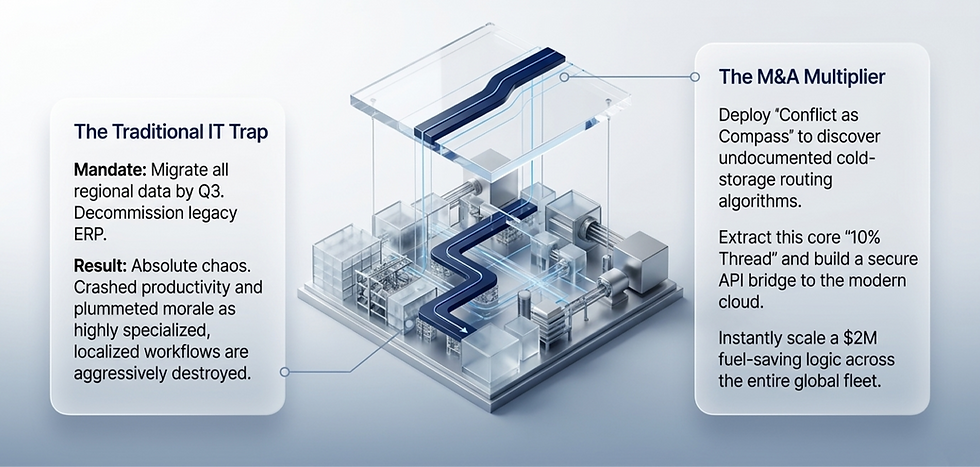
The Traditional IT Trap
The standard IT integration approach is brute force. The mandate comes down: "Migrate all regional logistics data to the cloud by Q3. Decommission the legacy ERP."
The result?
Absolute chaos. The acquired workforce realizes that the new cloud system doesn't account for their specialized pallet-stacking algorithms or their local vendor routing workarounds. Productivity plummets. Deliveries are missed. Employee morale craters because you just took away the tools that made them experts. The M&A Synergies you promised the board are stalled by internal friction.

The Principal Architect’s Solution (The M&A Multiplier):
We deploy a completely different playbook. We do not bulldoze; we illuminate.
The Diagnostic Translation First, we deploy the "Conflict as Compass" methodology. We sit with the floor managers who use the green-screen system. We don't ask them about the code; we ask them about the work. We discover that the legacy system has a brilliant, undocumented algorithm for optimizing cold-storage weight distribution that saves the company $2M a year in fuel.
The Extraction (The 10% Thread) We isolate that specific business logic. We realize we only need to integrate this core 10% of the legacy logic to maintain their operational genius.
The Architectural Bridge Instead of forcing them onto a foreign system, we build an elegant, secure API layer over their legacy database. We extract the cold-storage algorithm and feed it directly into the parent company’s modern predictive cloud.
The Glass Box Visualization Finally, we design a unified, highly intuitive digital dashboard for the entire combined company. The newly acquired logistics experts get a beautiful, modern interface that still runs their genius algorithms in the background. The C-suite gets real-time, global visibility.
By taking the time to architect this connection, you didn't just preserve the value of the acquisition—you multiplied it. You scaled their $2M fuel-saving algorithm across your entire global fleet, unlocking massive, unexpected EBITDA.

The 2026 Red Horse Mandate: Architecting Rapid Momentum
In the high-stakes environment of M&A, speed is your greatest asset, but clarity is your greatest weapon. The clock on your Operational ROI starts ticking the exact second the deal closes. This is the moment for decisive, visionary action.
We cannot afford to spend twelve months in theoretical committee meetings mapping out perfect IT integrations. We need a "Chaos Pilot." We must dive directly into the complex, messy center of the acquired data, find the golden thread of logic, and visualize an elegant path forward.
The mandate is simple: Stop managing the integration purely from a balance sheet, and start aggressively architecting the operational flow. We are taking a fragmented, localized system and transforming it into a brilliant, unified engine where executives possess perfect operational intuition, and the workforce possesses perfect alignment.
The Strategic Practices for the C-Suite
To visualize how this transformation occurs, Operating Partners must utilize clear architectural frameworks. Below are four expansive tables designed to help you map, extract, and elevate the value of your acquired systems.

The Value Creation Checklist
How to translate localized operations into global M&A Synergies.
The Operational Opportunity | Example | The Architectural Solution | The Executive Multiplier (The Win) |
Hyper-Localized Data Logic | A regional pricing algorithm that consistently beats national competitors | Do not overwrite it. Extract the underlying logic via an integration layer and feed it into the parent company’s global pricing engine. | You immediately acquire a smarter pricing model, expanding margins across the entire combined portfolio. |
Specialized Workforce Workarounds | Employees using spreadsheets because the legacy CRM lacks a specific workflow | Identify the brilliant human intuition behind the spreadsheet. Engineer a new, elegant feature in the unified CRM that automates their exact manual process. | Instant adoption of the new tech stack. Employee trust skyrockets, and operational efficiency jumps exponentially. |
The "Tribal Knowledge" Black Box | A 20-year-old database managed by two senior developers | Deconstruct the undocumented brilliance. Map the inputs and outputs, and rebuild the logic into a transparent, scalable microservice. | You eliminate key-person risk while permanently capturing their genius within your Enterprise Architecture. |

The Synergy Transformation
The evolution of the asset from acquisition to unassailable momentum.
The Acquisition Reality (Pre-Architecture Potential) | The Integration Advantage (Post-Architecture Power) |
The acquired company has decades of highly accurate, granular historical data trapped in localized silos. | That granular data is unleashed into a unified data lake, powering predictive AI models that give the C-suite a massive market advantage. |
System consolidation is viewed by the board as a high-risk, expensive IT cost center. | System Consolidation is celebrated as the primary driver of unexpected revenue and the ultimate M&A Multiplier. |
Complex, specialized workflows make the newly acquired company difficult to manage from the parent headquarters. | Complexity is elegantly translated into crystal-clear visual dashboards, providing executives with effortless, intuitive steering power. |

The "Black Box to Glass Box" Matrix
How a Principal Architect illuminates trapped value.
Dimension | The "Black Box" State (Untapped) | The "Glass Box" State (Unlocked) |
Visibility | Opaque. Executives rely on static, weekly reports generated by localized IT teams. | Transparent. Executives interact with real-time, intuitive visual dashboards that tell the exact story of the business. |
Scalability | Rigid. The legacy system works perfectly for 500 employees but will break if scaled to 5,000. | Elastic. The core brilliance of the legacy system is extracted and hosted on a scalable, cloud-native architecture. |
User Experience | High friction. Requires years of specialized training to navigate complex, outdated interfaces. | High intuition. The complex backend logic is paired with a consumer-grade, beautiful interface that new hires master on Day One. |

The 72-Hour Audit Scorecard for Operational Gold
What to look for immediately post-close to find hidden value.
Diagnostic Target | What You Are Looking For | Why It Matters for Deal Value |
The Friction Nodes | Where does data require manual human intervention to move from System A to System B? | These nodes are where your top talent is wasting their genius. Automating these bridges reclaims thousands of hours of ROI. |
The Custom Fields | What highly specific, weirdly named custom fields exist in their CRM or ERP? | These fields represent unique customer insights or operational nuances that your parent company probably doesn't track (but should). |
The "Don't Touch" Servers | Which legacy systems is the acquired IT team fiercely protective of? | Fear indicates value. That server holds the critical, load-bearing business logic that makes the acquired company profitable. |

The Actionable Blueprint: Mobilizing for Value Creation
Understanding the opportunity is only the first step. Tomorrow morning, you need to mobilize your integration team to start unlocking this vault. Here is your step-by-step blueprint for executing the M&A Multiplier.
Step 1: Pause the Bulldozer
Immediately halt any IT initiatives that mandate "Rip and Replace" within the first 90 days. Issue a mandate that the goal of the integration is to extract and scale value, not just achieve software compliance.
Step 2: Deploy the Chaos Pilots
Send Principal Architects—not just traditional IT managers—to sit with the acquired company's most productive front-line workers. Have them utilize the "Conflict as Compass" method to map exactly how the work actually gets done. Find the brilliant workarounds and the hidden algorithms.
Step 3: Map the "10% Threads"
Identify the top 3 to 5 critical intersection points where the acquired company's localized brilliance can be immediately fed into the parent company's ecosystem (e.g., pricing logic, inventory routing, specialized customer data).
Step 4: Architect the API Bridges
Do not force a massive data migration yet. Build elegant, lightweight integration layers that allow the legacy systems to communicate their valuable data to your modern cloud infrastructure. Secure the flow of information first.
Step 5: Design the Glass Box
Once the data is flowing seamlessly, build a unified, highly visual digital interface. Give your newly merged workforce a beautiful, intuitive platform that empowers them to do their best work, powered by the combined intelligence of both companies.

Putting it all Together
The most lucrative acquisitions in the history of private equity are not achieved by simply buying a company and slashing its IT budget. The greatest financial wins belong to the visionaries who realize that the messy, complex legacy systems they just acquired are actually the raw materials for unprecedented operational dominance. Treating Enterprise Architecture as your primary growth lever is the single most profitable decision you can make in the PMI process.
You have the opportunity to architect a unified reality that multiplies the genius of your workforce and gives your executive team absolute, intuitive control over the new empire. The complex web of acquired technology is not a threat; it is a vault of immense, untapped potential waiting to be harnessed.
When you are staring down the labyrinth of a newly acquired company, you do not need to fear the chaos. You simply need the Universal Translator to illuminate the brilliance inside the Black Box, pull the right threads, and architect your company's most explosive chapter of growth yet.


Comments